The Best Gym Check-In Systems in 2026: Complete Guide
Why Gym Check-In Systems Matter More Than You Think
Every time a member walks through your door, it tells a story. How often they visit, which classes they attend, what time of day they prefer — all of it adds up to a detailed picture of engagement. And engagement is the single strongest predictor of member retention.
A reliable gym check-in system does far more than count heads. It captures the attendance data that drives smarter business decisions across your entire operation. Here is why that matters:
- Retention insight: Members who check in fewer than four times per month are statistically far more likely to cancel. A check-in system lets you spot declining attendance patterns before a member ghosts entirely — giving your team a window to reach out, re-engage, and save the membership.
- Class and program optimization: Accurate attendance data shows you which classes are packed, which ones are underperforming, and where there is room to add or consolidate sessions. Instead of guessing, you make scheduling decisions based on real usage.
- Revenue and capacity planning: When you know exactly how many people use your facility at any given hour, you can plan staffing, manage equipment demand, and even structure pricing tiers around peak and off-peak usage.
- Member accountability: Many members actually want their attendance tracked. It creates a sense of accountability, and features like attendance streaks and milestones turn consistency into something worth celebrating.
The bottom line: if you are running a gym, studio, or fitness facility without a proper check-in system, you are flying blind on the metrics that matter most.
Types of Gym Check-In Systems
Not all check-in methods are created equal. Each has trade-offs in terms of cost, speed, member experience, and the data it produces. Here is a breakdown of the most common types you will encounter in 2026.
QR Code Scanning (Phone-Based)
Members open their gym app, display a QR code on their phone screen, and scan it at the front desk or a kiosk. This is one of the fastest and most hygienic check-in methods available today.
Pros: No physical card required. Codes can be dynamically generated for security. Works seamlessly with member apps. Zero consumable cost — no cards to print or replace.
Cons: Requires members to have a smartphone with the app installed. Can be slightly slower if a member needs to open the app and navigate to the code.
QR code check-in has become the gold standard for modern gyms because it ties directly into the member’s digital profile, making the data capture instant and automatic.
Barcode Scanning (Card or Phone)
Barcode check-in works similarly to QR scanning, but uses a traditional one-dimensional barcode. This can be displayed on a phone screen or printed on a physical membership card or key tag.
Pros: Compatible with a wide range of existing barcode scanners. Physical cards give members a tangible token of membership. Proven, reliable technology.
Cons: Physical cards can be lost, forgotten, or damaged — leading to replacement costs and front-desk friction. Less data-dense than QR codes.
Many gyms use barcode scanning alongside QR codes, giving members the flexibility to check in whichever way is most convenient for them.
Kiosk and Tablet Check-In
A dedicated tablet or kiosk is placed at the gym entrance where members check themselves in. This might involve entering a PIN, scanning a code, or selecting their name from a list.
Pros: Creates a self-service experience that reduces front-desk workload. Can be branded with your gym’s logo and colors. Works for members who do not have smartphones. PIN-based kiosks eliminate the need for any physical token.
Cons: Requires dedicated hardware (tablet, stand, and sometimes a protective enclosure). Can create a bottleneck if there is only one kiosk during peak hours.
Kiosks are especially popular in studios and boutique gyms where the front desk handles sales and onboarding, and you want check-in to happen independently.
RFID Key Fob or Wristband
Members tap an RFID-enabled key fob, wristband, or card against a reader at the door. This is the technology behind most access-control-integrated check-in systems.
Pros: Extremely fast — just tap and go. Can double as an access control mechanism for doors and turnstiles. Durable physical tokens last a long time.
Cons: Higher upfront cost for readers and fobs. Members can lose or forget their fob. Replacing lost fobs adds ongoing operational cost. Less flexible than app-based solutions when it comes to data and integrations.
RFID is common in larger facilities and 24-hour gyms where unmanned access control is a priority. It works best when paired with software that can log and report on the data the reader captures.
Manual Check-In
A staff member at the front desk looks up the member in the system and marks them as checked in. This can also include sign-in sheets — yes, some gyms still use paper.
Pros: Personal interaction at the door. No technology required on the member’s side. Simple to implement.
Cons: Slow and labor-intensive. Prone to human error and missed check-ins. Difficult to scale. Paper logs are nearly impossible to analyze for trends.
Manual check-in made sense when gyms were small and personal. In 2026, it is the least efficient option and should only serve as a fallback, not a primary system.
App-Based Self Check-In
Some systems allow members to check in directly through their mobile app using GPS or Bluetooth proximity detection — no scanning required. The app recognizes that the member is physically at the gym and logs the visit automatically or with a single tap.
Pros: Frictionless experience. No hardware needed at the gym. Works well for outdoor boot camps and off-site sessions where there is no front desk.
Cons: GPS accuracy can vary. Some members may have location services disabled. Slightly higher risk of false check-ins if geofencing is not configured tightly.
App-based self check-in is growing in popularity, particularly for personal trainers, small studios, and hybrid fitness businesses that operate across multiple locations or outdoor venues.
What to Look for in a Gym Check-In System
Choosing a check-in system is not just about the scanning method. The real value lies in what happens with the data after a member checks in. Here are the features that separate a basic check-in tool from a system that actually helps you grow your business.
Integration with Your CRM and Member Management
Your check-in system should feed data directly into your member profiles. When a staff member opens a client record, they should immediately see attendance history, visit frequency, and trends — without switching between systems or exporting spreadsheets.
Disconnected tools create data silos. An integrated system means every check-in enriches your understanding of each member automatically.
Attendance Reporting and Dashboards
Raw check-in data is only useful if you can visualize and act on it. Look for a system that provides clear dashboards showing daily, weekly, and monthly attendance trends. You should be able to filter by class, trainer, time of day, and membership type.
The best systems also let you identify at-risk members — those whose attendance has dropped below a threshold you define — so you can intervene before they cancel.
Automation Triggers Based on Attendance
This is where check-in systems become truly powerful. Can your system automatically send an email or push notification when a member hits a milestone (50 visits, one-year streak)? Can it trigger a re-engagement workflow when someone has not visited in two weeks?
Automation turns passive data collection into active member engagement — without adding work to your team’s plate.
Member-Facing App
A dedicated member app that handles check-in alongside booking, scheduling, and account management creates a unified experience. Members should not need one app to book a class and a different process to check in.
Look for apps that support iOS, Android, and ideally a Progressive Web App (PWA) so that every member can access the system regardless of their device.
Multi-Location Support
If you operate more than one facility — or plan to — your check-in system needs to work seamlessly across locations. Members should be able to check in at any branch, and your reporting should aggregate data across the business while still allowing per-location breakdowns.
Speed and Reliability
A check-in system that is slow, buggy, or frequently offline is worse than no system at all. It frustrates members and creates front-desk chaos during peak hours. Whatever system you choose, test it under real conditions before committing. A one-second check-in should be the standard, not the exception.
How FitProTracker Handles Gym Check-In
FitProTracker was built with the understanding that check-in is not just an operational task — it is a data-collection opportunity that powers retention, engagement, and smarter business decisions. Here is how the platform approaches it.
QR Code Check-In (MECARD Format)
Every member gets a unique QR code in the FitProTracker client app. The code uses the MECARD format, which is compact, widely compatible, and fast to scan. Members simply open their app, display the code, and scan at the front desk or kiosk. The check-in is logged instantly against their profile.
Barcode Check-In
For gyms that already use barcode scanners — or for members who prefer a physical card — FitProTracker also supports barcode-based check-in directly through the client app. This gives you flexibility without requiring additional hardware investments.
In-Gym Kiosk Mode
FitProTracker includes a dedicated kiosk mode designed for front-desk tablets. The kiosk is PIN-protected to prevent unauthorized access, fully branded with your gym’s identity, and optimized for fast, self-service check-in. Members can scan their code or search by name — either way, the process takes seconds.
This is especially useful for studios and facilities where front-desk staff are handling consultations, sales, or onboarding and cannot manually check in every arriving member.
Client App Across All Platforms
The FitProTracker client app is available on iOS, Android, and as a Progressive Web App. This means every member has access to their QR code, barcode, booking tools, and attendance history regardless of what device they use. No one is left out because they have the wrong phone or do not want to download an app — the PWA runs directly in the browser.
Session Attendance Tracking
Beyond general facility check-in, FitProTracker tracks attendance at the session level. When a member checks in for a specific class or personal training appointment, the system records it against that session — not just as a generic gym visit. This gives you precise data on class popularity, trainer utilization, and no-show rates.
Attendance Milestones and Engagement
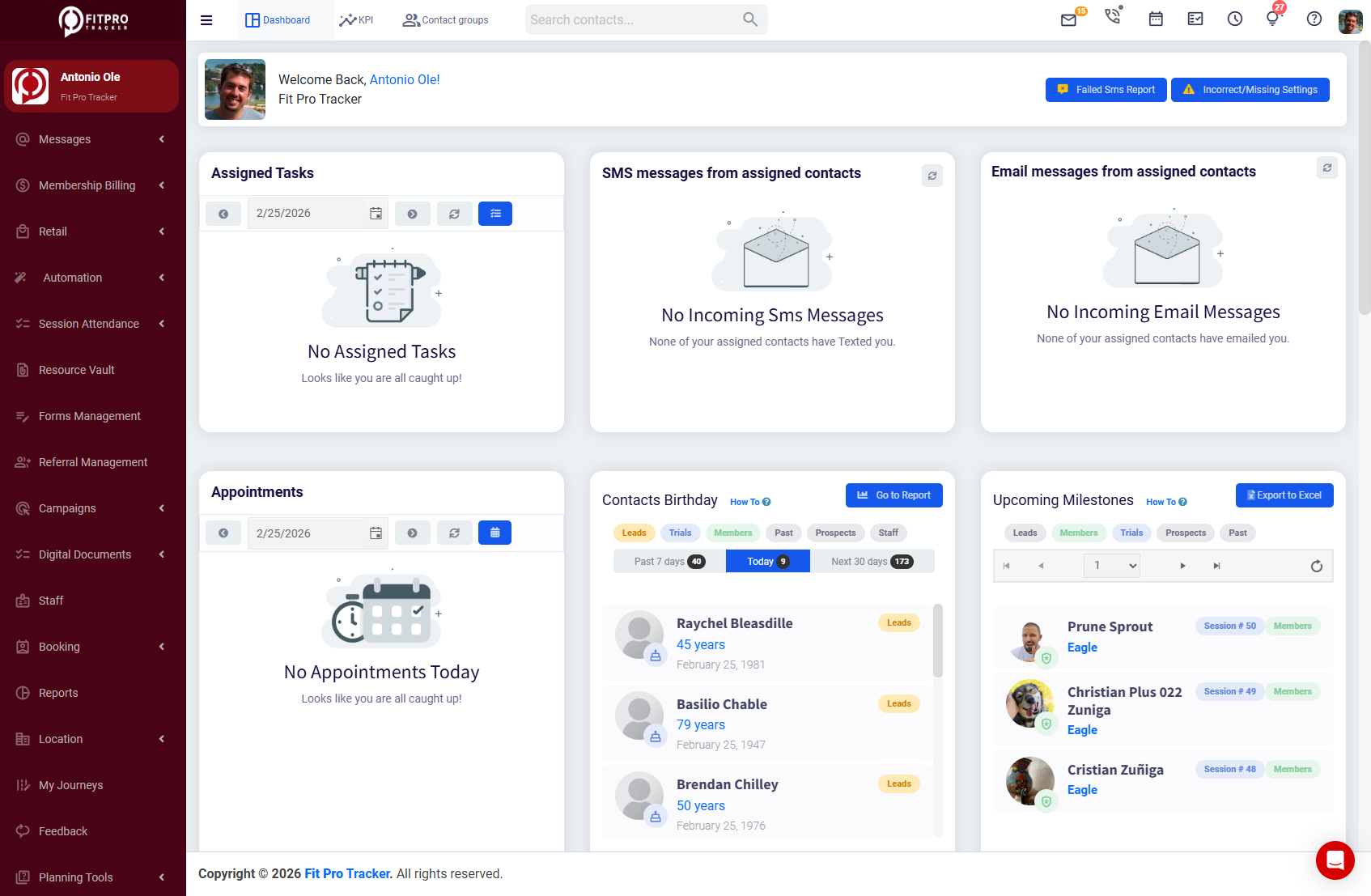
FitProTracker automatically tracks attendance milestones for every member. Whether it is their 10th visit, 100th visit, or a consecutive-week streak, the system recognizes the achievement. These milestones can be used to trigger automated messages — a congratulatory email, a small reward, or a social media shout-out prompt.
This turns routine data into meaningful member touchpoints that build loyalty and community.
Attendance Reports and Dashboards
All check-in data flows into FitProTracker’s reporting dashboards, where you can view attendance trends across your entire business or drill down to individual members, classes, trainers, and locations. Spot declining attendance early, identify your most engaged members, and make data-driven decisions about scheduling, staffing, and programming.
Choosing the Right System for Your Gym
The best gym check-in system is the one your members will actually use and that gives you the data you need to make better decisions. Here is a quick framework for choosing:
- Small studio or personal training business: Prioritize app-based check-in with QR codes. Low cost, minimal hardware, and maximum flexibility.
- Mid-size gym with a front desk: Combine kiosk check-in with QR and barcode options. This covers members who prefer self-service and those who want a quick scan.
- Large facility or multi-location operation: Look for a platform that integrates check-in with your full member management stack — CRM, billing, scheduling, and reporting. Avoid standalone check-in tools that create data silos.
- 24-hour or unmanned facility: RFID or app-based check-in with access control integration is essential. You need a system that works reliably without staff present.
Regardless of your gym’s size, the non-negotiables remain the same: the system must be fast, reliable, integrated with your member data, and capable of producing actionable reports.
Start Tracking Attendance the Right Way
A gym check-in system is one of the simplest tools you can implement — and one of the highest-impact when it comes to understanding your members and reducing churn. The data it produces touches every part of your business, from scheduling and staffing to retention and revenue.
FitProTracker gives you QR code check-in, barcode scanning, a branded kiosk mode, a cross-platform client app, session-level attendance tracking, milestone automation, and comprehensive reporting dashboards — all in one platform built specifically for gym and studio owners.
Try FitProTracker free and see how effortless gym check-in — and the insights it unlocks — can be.