The Best Gym Management Software in 2026: Honest Comparison
Choosing the right gym management software can make or break your business. The wrong platform drains your budget with hidden fees, forces you to duct-tape together a dozen separate tools, and leaves your staff frustrated. The right one streamlines everything — from member sign-ups to billing to daily communication — so you can focus on what actually matters: helping people get results.

We spent weeks evaluating seven of the most popular gym management platforms on the market in 2026. This is not a paid ranking. We looked at real pricing, actual feature sets, user feedback, and day-to-day usability. Whether you run a 2,000-member big box gym or a 150-member CrossFit box, this guide will help you make a smarter decision.
What to Look for in Gym Management Software
Before we get into the reviews, let’s establish the criteria that actually matter. Too many comparison articles focus on surface-level features while ignoring the things that impact your bottom line. Here’s what we evaluated each platform on:
- All-in-One Capability: Does the platform handle CRM, billing, scheduling, communication, and reporting in a single system — or do you need to buy add-ons and third-party integrations to get a complete solution?
- Transparent Pricing: Can you see the price before you book a sales call? Are there per-member fees, transaction surcharges, or hidden costs that inflate your bill as you grow?
- Communication Tools: Does it include SMS, email, and phone calling built in? Or do you need to pay for Twilio, Mailchimp, and a separate VoIP service?
- Point-of-Sale (POS): Can you sell retail, supplements, and merchandise directly through the platform?
- Member & Staff Apps: Are there dedicated mobile apps for both your clients and your team?
- Automation & Workflows: Can you automate lead follow-ups, past-due billing reminders, and member retention campaigns?
- Reporting & KPIs: Does the platform give you real-time dashboards with the metrics gym owners actually need — revenue per member, churn rate, lead conversion, attendance trends?
- Ease of Use: How steep is the learning curve? Can your front-desk staff learn the system in days, not weeks?
- Contract Flexibility: Are you locked into a 12-month contract, or can you leave if the platform doesn’t deliver?
With those criteria in mind, let’s look at how each platform stacks up.
Quick Comparison Table
| Platform | Price | Key Features | Best For |
|---|---|---|---|
| Fit Pro Tracker | $299/mo flat | 275+ features, CRM, SMS, email, calling, billing, POS, client app, staff app, digital docs, scheduler, KPIs, funnel builder, kiosk, 20+ integrations | Gym owners who want everything in one platform with no surprises |
| Mindbody | $139–$700+/mo | Marketplace, booking, payments, branded app (add-on), spa/wellness tools | Spa and wellness studios wanting marketplace exposure |
| PushPress | Free–$249/mo | Core membership management, billing, booking; Train & Grow sold separately | CrossFit boxes on a tight budget (free tier) |
| Wodify | ~$79–$399/mo | Workout tracking, performance leaderboards, WOD marketplace, billing | CrossFit-only gyms focused on programming |
| Zen Planner | ~$99–$248/mo | Scheduling, billing, belt tracking, member management | Martial arts schools and small studios |
| Glofox (ABC Fitness) | Custom (~$100–300+/mo) | Branded member app, booking, payments, reporting | Boutique fitness studios wanting a polished app |
| Gymdesk | $75–$125/mo | Member management, scheduling, billing, basic reporting | Small gyms or studios needing a simple, affordable tool |
Detailed Reviews
1. Fit Pro Tracker — The All-in-One Powerhouse
Price: $299/month flat — no per-member fees, 12-month commitment
Website: fitprotracker.com
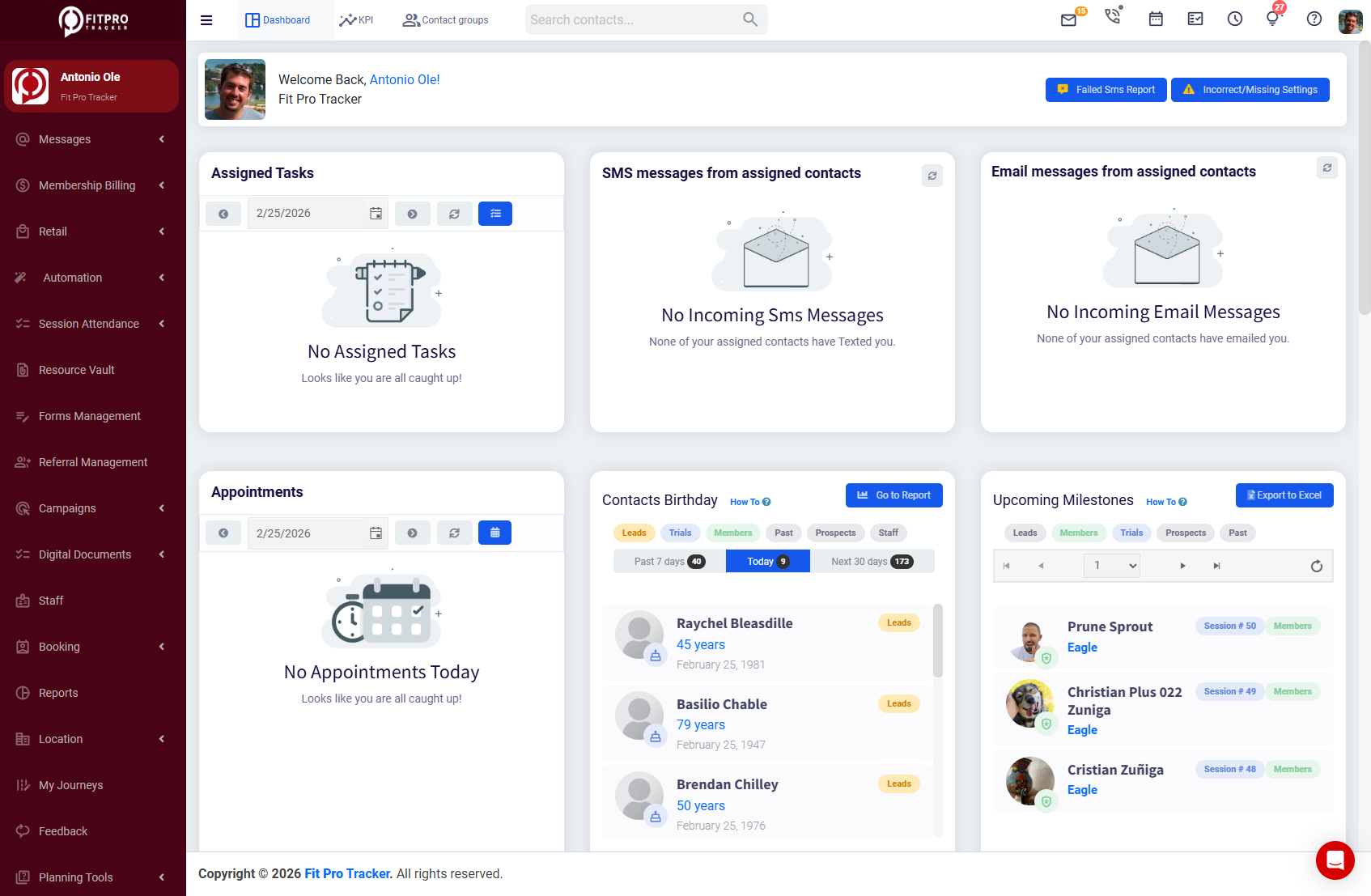
Fit Pro Tracker was built by Antonio Olander, an actual gym owner who got tired of paying for five different platforms just to run one business. That origin story matters because you can feel it in the product — every feature exists to solve a real operational problem, not to pad a marketing brochure. With 275+ features packed into a single flat-rate subscription, FPT covers CRM, SMS and email marketing, built-in calling (yes, a real phone dialer inside the platform), payment processing, point-of-sale, a branded client app, a dedicated staff app, digital document signing, class and appointment scheduling, KPI dashboards, a funnel builder, a self-service kiosk, and over 20 integrations. That is not a typo — all of that is included at $299 per month with no per-member surcharges.
Where Fit Pro Tracker genuinely stands out is in the areas most competitors treat as afterthoughts. The built-in calling feature eliminates the need for a separate VoIP service — your sales team can call leads directly from the CRM, and every call is logged automatically. The POS system means you can sell retail, supplements, and merchandise without bolting on Square or Shopify. The staff app gives your team mobile access to schedules, tasks, and member info without needing to share a login to the main dashboard. And the automation engine lets you build multi-step workflows for lead nurture, trial follow-up, past-due billing, and member re-engagement — all without touching a third-party tool like Zapier.
The honest downside? Fit Pro Tracker is a newer brand compared to legacy players like Mindbody. It doesn’t have the same level of name recognition, and its user community is still growing. If you’re someone who needs the comfort of choosing the biggest name in the room, that might give you pause. But if you evaluate software on what it actually does, feature for feature, dollar for dollar, FPT is extremely difficult to beat in 2026. For a gym owner who wants one login, one bill, and one platform that handles everything, this is the clear frontrunner.
Verdict: Best overall value. No other platform delivers this breadth of features at this price point without nickel-and-diming you as you grow.
2. Mindbody — The Industry Giant
Price: $139–$700+/month (plans start at $139 but most studios need the $279+ tier for essential features)
Best for: Spa, wellness, and yoga studios wanting marketplace visibility
Mindbody is the name everyone knows, and that brand recognition is its greatest asset. The Mindbody marketplace — a consumer-facing app where people discover and book classes at local studios — is a genuine lead-generation channel that no other platform on this list can replicate. If you run a yoga studio, a Pilates boutique, or a day spa in a competitive urban market, that marketplace exposure has real value. Mindbody also offers a broad feature set that covers scheduling, payments, retail, staff management, and reporting. The platform is mature, well-documented, and has a large ecosystem of integrations.
The problems start with pricing. Mindbody’s plans range from $139 to over $700 per month, with most studios landing on the $279+ tier, and that’s before you factor in add-ons like their branded app, advanced marketing tools, or AI-powered features — each of which can add $100 or more to your monthly bill. There are also per-transaction fees and, depending on your plan, per-member costs that make the total expense unpredictable. For a mid-size gym doing $30K–$50K in monthly revenue, you could easily spend $800 or more per month on Mindbody once everything is layered in. The platform is also built more for the spa and wellness vertical than for traditional gyms, CrossFit boxes, or strength and conditioning facilities. If you’re running a gym with barbells and squat racks, you may find that many of Mindbody’s features are designed for a clientele you don’t serve.
Credit where it’s due: Mindbody’s marketplace is unmatched, their consumer brand awareness is enormous, and if you operate in the spa or wellness space, it remains a top-tier choice. But for gym owners specifically, the price-to-value ratio is hard to justify when alternatives deliver more gym-specific functionality at half the cost.
Verdict: Best brand recognition and marketplace. But the premium pricing and spa-centric design make it a tough sell for traditional gym owners.
3. PushPress — The CrossFit Community Favorite
Price: Free tier available; paid plans $159–$249/month
Best for: CrossFit boxes looking for a free or low-cost starting point
PushPress has earned a loyal following in the CrossFit community, and for good reason. The free tier — PushPress Core — gives new or budget-conscious gym owners access to basic member management and billing without spending a dime. That’s a real differentiator for someone opening their first box with limited capital. The PushPress team has also built strong community goodwill through their podcast, educational content, and active presence at CrossFit events. The paid plans add more robust features including a branded member app and enhanced billing tools.
The catch is that PushPress operates on an add-on model. The core platform handles membership and billing, but if you want workout tracking and programming, you need PushPress Train (a separate product). If you want marketing automation, lead management, and a website builder, you need PushPress Grow (another separate product). By the time you’ve assembled the full stack, your monthly cost can climb well beyond the base price — and you’re still managing what are essentially separate products under one brand umbrella. There’s no built-in calling, no POS system, and the automation capabilities at the lower tiers are limited compared to platforms that include everything out of the box.
If you’re running a small CrossFit box and need to keep costs as low as possible, PushPress Core is a legitimate option to get started. But as your gym grows and your operational needs become more complex, the add-on model starts to feel like a ceiling rather than a foundation. You’ll eventually face the same problem PushPress was supposed to solve: paying for multiple tools to do what one platform should handle.
Verdict: Best free option for new CrossFit boxes. But the fragmented product suite limits long-term value.
4. Wodify — Built for the CrossFit Box
Price: ~$79–$399/month (starts low but scales quickly as you add features)
Best for: CrossFit affiliates who prioritize workout tracking and programming
Wodify was one of the first platforms built specifically for the CrossFit community, and that heritage shows in its strengths. The workout tracking and performance features are best-in-class for the CrossFit use case — members can log WODs, track PRs, and compare performance on leaderboards. The workout marketplace gives coaches access to a library of pre-built programming they can plug directly into their schedule. If your members live and die by their Fran time, Wodify delivers that experience better than most.
Where Wodify falls short is everywhere outside the whiteboard. The CRM is basic — fine for managing your current members, but lacking the depth you need for serious lead management and sales pipeline tracking. Communication tools are limited compared to platforms with built-in SMS, email marketing, and calling. And if your gym isn’t a CrossFit box — if you run a globo gym, a personal training studio, or a hybrid facility — Wodify’s feature set starts to feel narrow. The platform was built for one niche and it serves that niche well, but it hasn’t evolved into a true all-in-one solution.
For a dedicated CrossFit affiliate that values programming and performance tracking above all else, Wodify is a solid pick. Just know that you’ll likely need additional tools for lead generation, marketing automation, and retail operations.
Verdict: Best workout tracking for CrossFit. Limited as a complete business management platform.
5. Zen Planner — The Martial Arts Staple
Price: ~$99–$248/month (starts at $99 with limited features, scaling as you add what FPT includes by default)
Best for: Martial arts schools and small community studios
Zen Planner has carved out a strong niche in the martial arts community. Features like belt tracking, rank progression, and family billing make it a natural fit for dojos, BJJ academies, and taekwondo schools. The scheduling and booking system is reliable, and the member management tools cover the basics well. For a martial arts school owner who needs a straightforward system to manage classes, memberships, and belt promotions, Zen Planner checks the essential boxes.
The platform’s weaknesses become apparent when you need more than the basics. The interface feels dated compared to newer competitors — it’s functional but not intuitive, and the learning curve for new staff can be steeper than it should be. Communication tools are limited; you won’t find built-in calling, and the email and SMS capabilities don’t match what dedicated marketing platforms (or all-in-one competitors like Fit Pro Tracker) offer. Reporting exists but lacks the depth and customization that data-driven gym owners expect in 2026. Zen Planner also doesn’t offer a POS system, so retail sales require a separate solution.
If you run a martial arts school and the belt-tracking features are a must-have, Zen Planner deserves a spot on your shortlist. For general gym owners or those who want a modern, full-featured platform, there are better options available today.
Verdict: Best for martial arts schools. Showing its age for everyone else.
6. Glofox (ABC Fitness) — The Boutique Studio Play
Price: Custom pricing (typically $100–300+/month depending on features and gym size)
Best for: Boutique fitness studios wanting a polished member app
Glofox — now part of ABC Fitness Solutions — has positioned itself as the go-to platform for boutique fitness studios. The branded member app is one of the best-looking in the industry, and for studios where the member experience and brand aesthetics matter, that’s a meaningful advantage. The booking flow is smooth, the interface is clean, and the overall user experience is polished. If you run a cycling studio, a barre class, or a boutique HIIT gym and you want your members to interact with a beautiful app, Glofox delivers on that front.
The frustration starts before you even become a customer: there’s no transparent pricing on the website. You have to book a demo and go through a sales process to find out what you’ll pay, which in 2026 feels unnecessarily opaque. Once you’re in, the feature set is solid but not comprehensive — you won’t find the depth of CRM tools, built-in calling, or advanced automation that some competitors offer. The ABC Fitness acquisition has brought more resources to the platform, but it has also created some uncertainty about the product roadmap and whether Glofox will maintain its identity or get absorbed into ABC’s broader enterprise-focused ecosystem.
For boutique studio owners who value design and member experience above raw feature count, Glofox is worth evaluating. But the lack of pricing transparency and the narrower feature set compared to true all-in-one platforms are real drawbacks.
Verdict: Best-looking member app. But opaque pricing and limited feature depth hold it back.
7. Gymdesk — The Budget-Friendly Starter
Price: $75–$125/month
Best for: Small gyms or studios that need a simple, affordable tool
Gymdesk is the most affordable option on this list, and for a small gym owner just getting started, that low price point is genuinely appealing. The platform covers the fundamentals — member management, class scheduling, billing, and basic reporting — with a clean, modern interface that’s easy to learn. If you’re a solo trainer or a small studio owner with 50–100 members and you just need something that works without breaking the bank, Gymdesk gets the job done.
The trade-off is that you get what you pay for. There’s no built-in calling. No POS system. No advanced automation or workflow builder. No funnel builder. No staff app. The CRM is basic, and the marketing tools are limited. As your gym grows beyond that initial stage — when you start hiring staff, running ad campaigns, managing a sales pipeline, and needing deeper reporting — Gymdesk’s simplicity becomes a limitation. You’ll either outgrow the platform or start layering in additional tools, which erodes the cost advantage that made Gymdesk attractive in the first place.
Gymdesk is an honest product at an honest price. It doesn’t pretend to be more than it is. For very small operations, it’s a smart, affordable starting point. Just plan for the likelihood that you’ll need to migrate to something more robust as your business scales.
Verdict: Best budget option for very small gyms. Limited growth runway.
Ready to see Fit Pro Tracker in action?
Book a free walkthrough and see how all 275+ features work together in one platform — no pressure, no hard sell.
The Final Verdict: Which Gym Management Software Should You Choose in 2026?
Every platform on this list has a legitimate use case. There is no single “best” software for every gym on the planet — your choice should depend on your size, budget, business model, and operational priorities. Here’s the honest breakdown:
- If you want the best overall value and a true all-in-one platform: Fit Pro Tracker is the clear winner. 275+ features, $299/month flat, no per-member fees, 12-month commitment. Nothing else on the market matches that combination of depth and affordability.
- If marketplace exposure is critical and budget isn’t a concern: Mindbody’s consumer marketplace is unrivaled, especially for spa and wellness businesses.
- If you’re a new CrossFit box with almost no budget: PushPress Core gives you a free starting point, though you’ll likely outgrow it.
- If you’re a CrossFit box obsessed with programming and performance: Wodify’s workout tracking features are purpose-built for you.
- If you run a martial arts school: Zen Planner’s belt tracking and rank progression features are hard to find elsewhere.
- If you run a boutique studio and brand aesthetics are everything: Glofox delivers the most polished member-facing app.
- If you’re a very small gym and need the cheapest possible option: Gymdesk covers the basics at the lowest price point.
But here’s the reality most gym owners face: you don’t just need scheduling software. You don’t just need a billing tool. You need a complete operating system for your business — one that handles CRM, communication, marketing, sales, billing, POS, scheduling, reporting, and staff management without requiring you to pay for half a dozen separate subscriptions. When you evaluate these platforms through that lens, the math overwhelmingly favors Fit Pro Tracker.
Ready to See Fit Pro Tracker in Action?
We get it — reading a comparison article is one thing. Seeing the software actually work for your gym is another. That’s why we offer a free walkthrough where we’ll show you exactly how Fit Pro Tracker handles the specific workflows your gym depends on — from lead capture to member onboarding to daily operations.
No pressure. Simple 12-month commitment. No per-member fees. Just 275+ features at one flat rate.
See why gym owners are choosing Fit Pro Tracker in 2026.