The Hidden Cost of Using Multiple Software Tools at Your Gym
You opened a gym because you love fitness — not because you wanted to become an IT manager juggling half a dozen software subscriptions. Yet here you are, tabbing between your CRM, your texting platform, your email tool, your billing system, your scheduler, and your POS terminal, just to onboard a single new member.
Sound familiar?
If you run a gym, studio, or fitness facility, there is a very good chance you are paying far more than you realize for your software stack. And the dollar amount on your credit card statement is only the beginning. The real cost — the one that silently eats into your profit margin every single month — hides in lost time, lost leads, frustrated staff, and decisions made on incomplete data.
Let’s pull back the curtain on what that patchwork of tools is actually costing you.
The Typical Gym Software Stack — And What You’re Really Paying
Most gym owners don’t set out to accumulate six, seven, or eight different software tools. It happens gradually. You start with a billing platform because you need to collect dues. Then you add an email marketing tool. Then someone tells you about a great SMS service. Before you know it, you’re managing a small software empire.
Here’s what the average gym owner’s tech stack looks like — and what each piece costs per month:
| Software Category | Common Tools | Typical Monthly Cost |
|---|---|---|
| CRM | HubSpot, Keap, Salesforce | $50 – $300 |
| SMS / Texting | SimpleTexting, Twilio, SlickText | $50 – $150 |
| Email Marketing | Mailchimp, Constant Contact, ActiveCampaign | $30 – $100 |
| Billing / Membership Management | Mindbody, Zen Planner, ClubReady | $150 – $400 |
| Scheduling | Acuity, Calendly, BookingKoala | $20 – $50 |
| Phone System | Grasshopper, RingCentral, OpenPhone | $30 – $80 |
| POS (Point of Sale) | Square, Clover, Stripe Terminal | $30 – $60 + per-transaction fees |
| TOTAL MONTHLY COST | $360 – $1,140/mo | |
Read that bottom line again. $360 to $1,140 every single month — and that’s before you factor in add-ons, overage charges, annual price hikes, and the per-transaction fees that tools like Square quietly skim off every supplement sale and retail purchase.
On the low end, that’s $4,320 per year. On the high end, you’re looking at $13,680 per year — spent on software tools that were never designed to work together.
But here’s the thing: the invoice total isn’t even the expensive part.
Hidden Cost #1: The Time You Lose Switching Between Apps
A study from the Harvard Business Review found that the average worker switches between applications roughly 1,200 times per day, losing about four hours per week to context-switching alone. Now think about your front desk staff. A prospect walks in, and here’s what happens:
- Open the CRM to log the new lead
- Switch to the scheduling tool to book a tour or intro session
- Jump to the email platform to trigger a welcome sequence
- Open the SMS tool to send a confirmation text
- Move to the billing platform to set up their trial or first payment
That’s five different applications, five different logins, and five different interfaces — just for one new prospect. Multiply that across every lead, every member check-in, every class booking, and every retail transaction that happens in your gym each day.
Your front desk team isn’t managing members. They’re managing software. And every minute they spend toggling between tabs is a minute they’re not greeting members, answering questions, or closing a sale standing right in front of them.
Hidden Cost #2: Data Silos That Keep You in the Dark
When your billing lives in Zen Planner, your lead pipeline lives in HubSpot, and your email engagement data lives in Mailchimp, no single system has the full picture.
Ask yourself these questions:
- Can you see, in one view, a member’s billing history and their email engagement and their last text conversation and their class attendance?
- When a member’s credit card declines, does your CRM automatically know — so you can trigger a retention workflow?
- When a lead opens three emails in a row, does your sales team get notified in the same place they make calls?
If the answer to any of these is “no,” you’re operating with data silos. And data silos don’t just create inconvenience — they create blind spots. You can’t manage what you can’t measure, and you certainly can’t measure it if the data is scattered across six unconnected platforms.
Gym owners who rely on fragmented tools often make critical business decisions — pricing changes, staffing decisions, marketing spend — based on incomplete information. That’s not a minor inefficiency. That’s a structural disadvantage.
Hidden Cost #3: Leads Falling Through the Cracks
This is the one that hurts the most, because it’s the one you usually can’t see happening.
A lead fills out a form on your website. It goes to your CRM. But your CRM doesn’t talk to your SMS tool, so the five-minute text follow-up that would have converted them into a booked appointment never fires. By the time someone manually notices the new lead and sends a text, it’s been four hours. The prospect has already booked a tour at the gym down the street.
Or consider this scenario: a lead gets entered into your CRM and your email tool, but not your phone system. Your sales team doesn’t see the lead in their call queue. Three days later, someone realizes the ball was dropped. They call. The prospect doesn’t remember filling out the form and isn’t interested anymore.
Speed to lead is everything in the gym industry. Research consistently shows that contacting a lead within the first five minutes increases conversion rates by up to 400%. But when your systems aren’t connected, speed to lead isn’t just slow — it’s completely dependent on whether a human remembers to manually bridge the gap between Tool A and Tool B.
How many leads slipped away last month because of that gap? You’ll never know. And that’s exactly the problem.
Hidden Cost #4: The Staff Training Nightmare
Every software tool has its own interface, its own logic, its own quirks. When you hire a new front desk associate, you’re not just training them on your gym’s processes — you’re training them on six to eight separate software platforms.
Think about what that means in practice:
- Longer onboarding time before new hires are productive
- More mistakes during the learning curve (mis-entered data, missed steps, duplicated records)
- Higher dependency on your most experienced staff, who become the only ones who “know how everything connects”
- Greater frustration for employees, which directly impacts turnover
The gym industry already struggles with front desk turnover. A convoluted tech stack makes the problem worse. Every time someone leaves and you hire a replacement, you’re repeating that multi-platform training cycle all over again — burning time and money every single time.
Hidden Cost #5: No Single Source of Truth
When member data exists in multiple systems, which one is “right”?
A member updates their phone number in the billing system but not in the CRM. Your marketing team sends an SMS campaign — and it goes to the old number. A member cancels through your scheduling tool, but the billing platform still charges them. Now you’ve got a chargeback, a bad Google review, and a former member telling everyone at the local CrossFit box that your gym can’t get its act together.
Without a single source of truth, data conflicts are inevitable. And cleaning up those conflicts — manually reconciling records across multiple platforms — becomes a recurring task that someone on your team has to own. That’s not productive work. That’s damage control for a problem that shouldn’t exist in the first place.
Hidden Cost #6: Integration Failures and Broken Automations
Maybe you’ve tried to solve the disconnection problem with integrations. Zapier, API connections, third-party middleware — the tools that promise to make your separate platforms “talk to each other.”
Here’s what they don’t tell you in the sales pitch: integrations break. Frequently.
- A software update on one platform changes an API endpoint, and your Zapier workflow silently stops working
- A data field format changes, and records start syncing incorrectly — or not at all
- You hit a rate limit on your integration plan, and data transfer pauses without warning
- Two platforms have conflicting data models, and the integration creates duplicate records instead of updating existing ones
The worst part? These failures are often silent. Nobody gets an alert. Nobody notices until a member complains, a lead disappears, or you pull a report and the numbers don’t add up. By then, you could have days or weeks of corrupted data to untangle.
And let’s not forget: Zapier itself costs money — often $50 to $100+ per month for the volume of tasks a busy gym requires. So you’re paying extra just to duct-tape together the tools you’re already overpaying for.
Hidden Cost #7: Vendor Management Overhead
Six tools means six vendor relationships. Six billing cycles. Six support teams. Six places to go when something breaks.
When a problem arises — and it always does — you get to play detective. Is the issue in your CRM? Your email tool? The integration layer? Your billing platform? You open a support ticket with Vendor A, who tells you it’s a Vendor B problem. Vendor B says it’s actually the integration. The integration support team says the data looks fine on their end. Meanwhile, your leads aren’t getting followed up with and your front desk is dead in the water.
This isn’t hypothetical. If you’ve lived it, you know exactly how demoralizing that support merry-go-round feels. And every hour you spend playing vendor referee is an hour you’re not coaching clients, training staff, or growing your business.
Adding It All Up: The True Cost of a Fragmented Tech Stack
Let’s do the real math — not just the subscription fees, but the full picture:
- Direct software costs: $360 – $1,140/mo ($4,320 – $13,680/year)
- Integration tools (Zapier, etc.): $50 – $100/mo ($600 – $1,200/year)
- Staff time lost to context-switching: 4+ hours/week = 200+ hours/year of lost productivity
- Lost leads due to slow follow-up: Even 2-3 lost conversions per month at $50/mo membership = $1,200 – $1,800/year in recurring revenue you never captured
- Staff training and re-training costs: Longer onboarding, higher turnover, repeated training cycles
- Bad data decisions: Impossible to quantify, but potentially the most expensive line item of all
Conservatively, a fragmented gym software stack costs the average facility $10,000 to $20,000+ per year when you account for both the direct and hidden costs. For a gym doing $30,000 to $50,000 per month in revenue, that’s a significant drag on your bottom line.
What the Alternative Looks Like
Imagine this instead: one platform. One login. One place where every lead, every member, every text, every email, every call, every payment, every class booking, and every staff interaction lives together — in real time.
No more toggling between six apps to onboard a new member. No more wondering if your CRM and billing system have the same phone number. No more silent integration failures at 2 a.m. No more training new hires on eight different platforms. No more calling three different support teams to solve one problem.
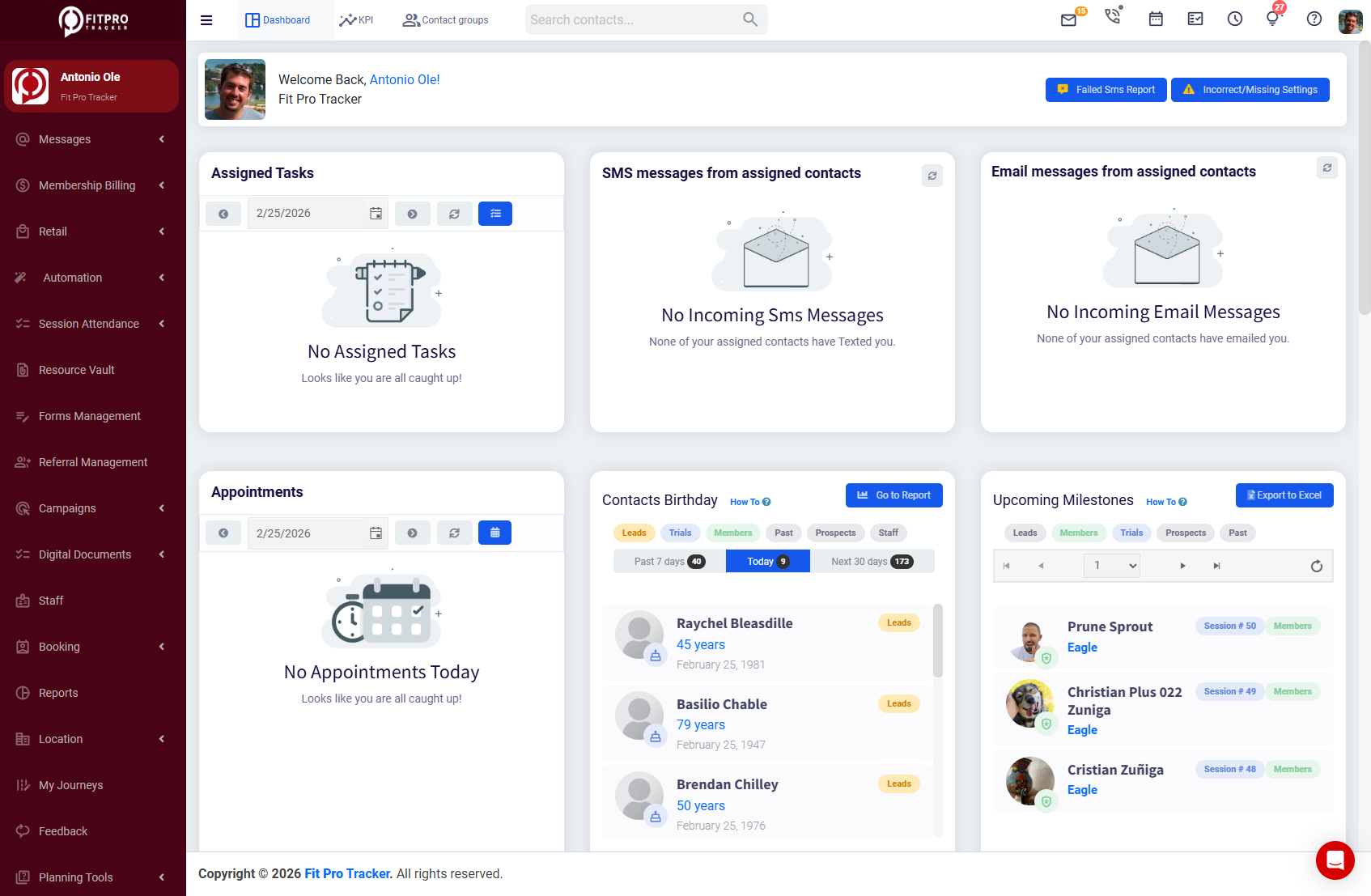
That’s exactly what an all-in-one gym management platform delivers. And FitProTracker was built specifically for this purpose — to replace the entire fragmented stack with a single, unified system purpose-built for gyms, studios, and fitness facilities.
Here’s what’s included at a flat $299/month:
- CRM — full pipeline management built for gym sales workflows
- Two-way SMS — text leads and members directly from the platform, with full conversation history
- Email marketing — campaigns, automations, sequences — all connected to your member data
- Built-in phone system — make and receive calls without a separate VoIP provider
- Billing and payment processing — recurring dues, packages, one-time charges, all in one place
- Point of sale — sell retail, supplements, and merchandise without Square or Clover
- Client app — a branded app your members actually use
- Staff app — keep your team connected and accountable on the go
- Digital documents — waivers, contracts, agreements — signed electronically and stored with the member record
- Scheduler — class scheduling, appointment booking, intro sessions — all connected to everything else
- KPI dashboards — real-time business metrics pulled from actual, unified data
- Funnel builder — landing pages and lead capture forms built for gym conversions
- Kiosk — member check-in at your front desk
- 20+ integrations — for the few external tools you still want to connect
All of it. One platform. One bill. $299/month.
The Question You Should Be Asking
The question isn’t “Can I afford to switch to an all-in-one platform?” The question is: “Can I afford not to?”
Every month you spend running your gym on a patchwork of disconnected tools, you’re paying more than you need to, losing leads you’ll never know about, burning staff hours on software management instead of member experience, and making business decisions based on fragmented data.
The hidden costs are real. They compound. And they don’t show up on any single invoice — which is exactly what makes them so dangerous.
If you’re ready to stop duct-taping your tech stack together and start running your gym on a single platform built for exactly this, take a look at FitProTracker. One platform. One price. Everything your gym needs to operate, sell, and grow — in one place.